

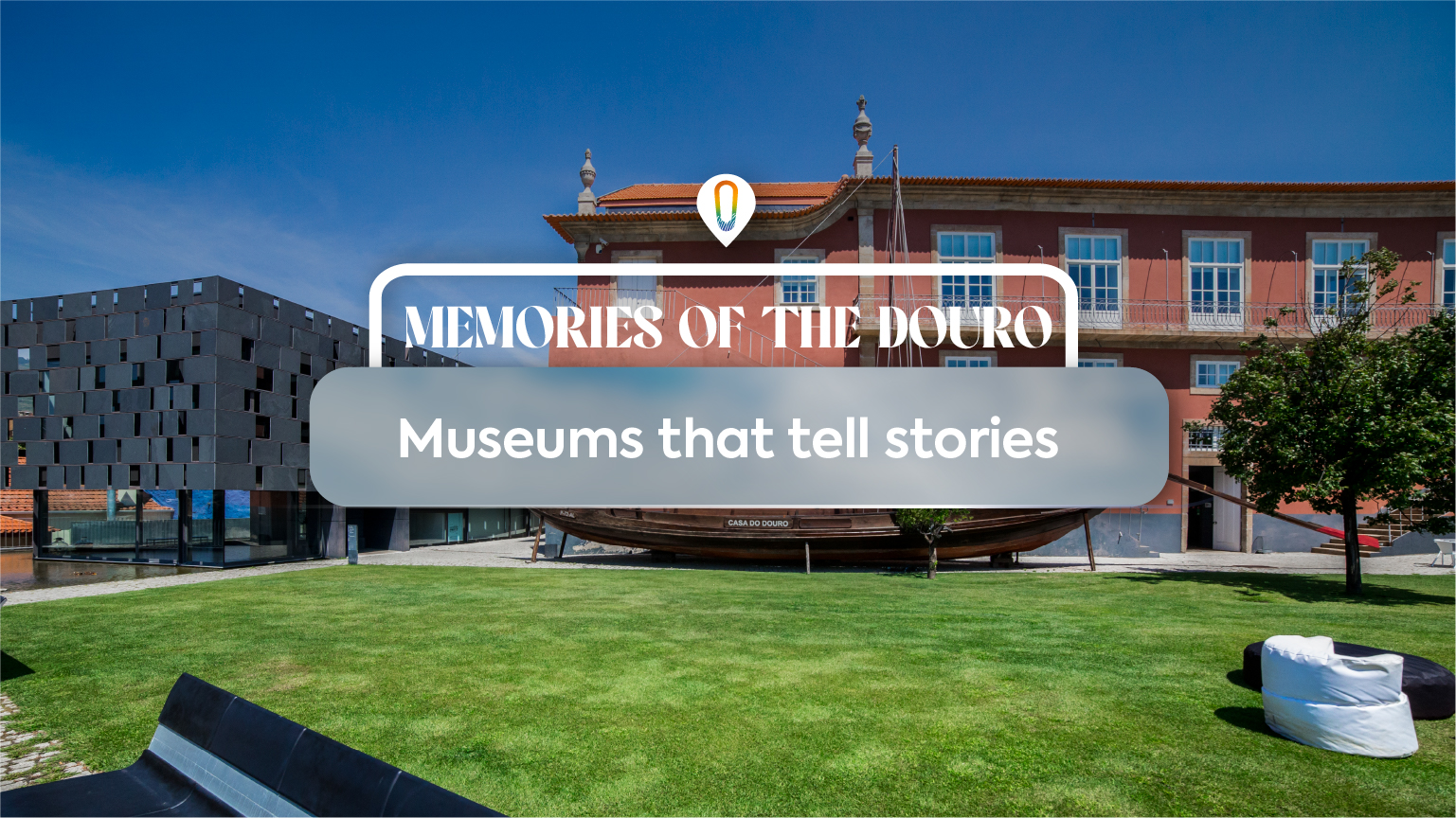
Discovering the Douro through its viewpoints, wine estates and vineyards is wonderful, but there is another way to truly reach the soul of the region: by visiting the museums and interpretive centres scattered across the 19 municipalities of CIM Douro. They are the ones that calmly tell the stories the landscape hints at but cannot explain on its own – the origins of the Demarcated Region, the hard work in the vineyards, the age-old rock art, the iron from the mountains, the role of the women of the Douro.
One of the best starting points is the Douro Museum, in Peso da Régua. Set right by the river, in a building linked to the old wine administration, it works almost like an instruction manual for the winegrowing region. Through work tools, photographs, audiovisual records and a carefully designed permanent exhibition, visitors can understand how the valley has been transformed over the centuries, from wild hillsides into a terraced landscape carved by hand. When you leave, the Douro is no longer just a beautiful backdrop: it becomes a historical, economic and human creation.
Further south, in Lamego, the Lamego Museum completes the puzzle, but from a different angle. Housed in the former Episcopal Palace in the historic centre, it opens the doors to an exceptionally rich artistic heritage: painting, sculpture, goldsmithery, azulejo tiles and archaeology. All of this is closely tied to the cathedral, the sanctuary, the religious orders and the city’s importance in the history of the region. It is an ideal place for those who like to connect art and place: we see paintings, altarpieces and devotional objects, and at the same time we read in them the power, faith and culture that also shaped the Douro.
If we head up to Vila Real, we find the Museum of Archaeology and Numismatics, which looks at the Douro from a less obvious angle: that of archaeology and coinage. Here, the journey goes even further back in time, passing through prehistoric, Roman and medieval remains, and through coin collections that help us understand how trade, exchange and economic relations shaped the inland north. For those using Vila Real as a base to explore the region, this museum is a delightful surprise and a great way to put the “before the vineyards” into context.
Among all these spaces, one stands out for its unique theme: the Interpretive Centre of the Women of the Douro, in Armamar. Unlike so many museums focused on great figures and institutions, this place shines a light on the women who worked (and still work) in the vineyards, in the home and in the villages, often in silence. Photographs, testimonies, documents and contemporary approaches reveal the invisible side of the Douro: effort, migration, the balance between family life and farm work, today’s challenges related to equality and the future of the territory. It is a space that truly moves visitors and is well worth including in any itinerary, especially for those who want a view of the region that goes beyond the picture-postcard image.
In São João da Pesqueira, the heart of the winegrowing Douro, the Wine Museum takes up the same theme of wine and landscape, but moves closer to the winepress and the glass. Installed in a former production site, it unfolds over several floors dedicated to viticulture, with granite lagares (treading tanks), audiovisual material, interactive areas and, usually, a tasting room and wine shop. It is a very “visitable” museum for every kind of audience: those who know about wine will still learn something new, those who don’t will start to build up their vocabulary and, above all, everyone will better understand what they are going to see outside, on the slopes and in the estates.
If we continue eastwards, the landscape changes – and so do the museums. In Torre de Moncorvo, the Museum of Iron and the Region of Moncorvo reveals another side of the Douro: iron and the mining industry. Here, wine steps out of the spotlight and ore takes its place – the ore that was mined in the mountains for decades, shaping the local economy, jobs and even the layout of the villages. Models, photographs, tools and documents help us understand how the Reboredo ridge and the Vilariça valley preserve another story of intense labour and close relationship with the land, one that is essential for understanding the wider territory of CIM Douro.
At the eastern tip of the sub-region, already overlooking the Côa, lies one of the most striking cultural spaces in the country: the Côa Museum, in Vila Nova de Foz Côa. Perched above the valley, almost as an extension of the rock itself, the building welcomes visitors and presents the rock art of the Côa Valley, classified as a UNESCO World Heritage Site – engravings carved in the open air, on stone, that testify to a human presence stretching back many thousands of years. The museum also serves as a gateway to guided visits to the archaeological sites in the surrounding landscape, bringing together science, tourism and nature. In a way, it proves that the importance of this region long predates wine, trains or river cruises: the Douro and its tributaries were already lived in, drawn and narrated when there was not yet even an idea of “Portugal”.
Alongside these big names, there are many other municipal spaces, ethnographic collections, small house-museums and thematic interpretive centres (on olive oil, local products, railway heritage, crafts, archaeology) spread across the 19 municipalities of CIM Douro. You don’t have to visit them all in a single trip, but including at least one museum or interpretive centre per day completely changes the way you experience the region. Instead of being “just” beautiful, the landscape gains layers: we start to see in the terraces the accumulated work of generations, in the small towns the traces of former bishoprics and markets, on the riverbanks the marks of boats, railway lines, mines and engravings.
For Discover Douro, this universe is an opportunity: suggesting itineraries that combine viewpoints, walking trails, wine estates and restaurants with one or two museum stops per day is a way of offering visitors a more complete, more mindful and more respectful experience of the territory. Travelling through the Douro thus becomes not only an aesthetic pleasure, but also an encounter with its history, its culture and its people.


