

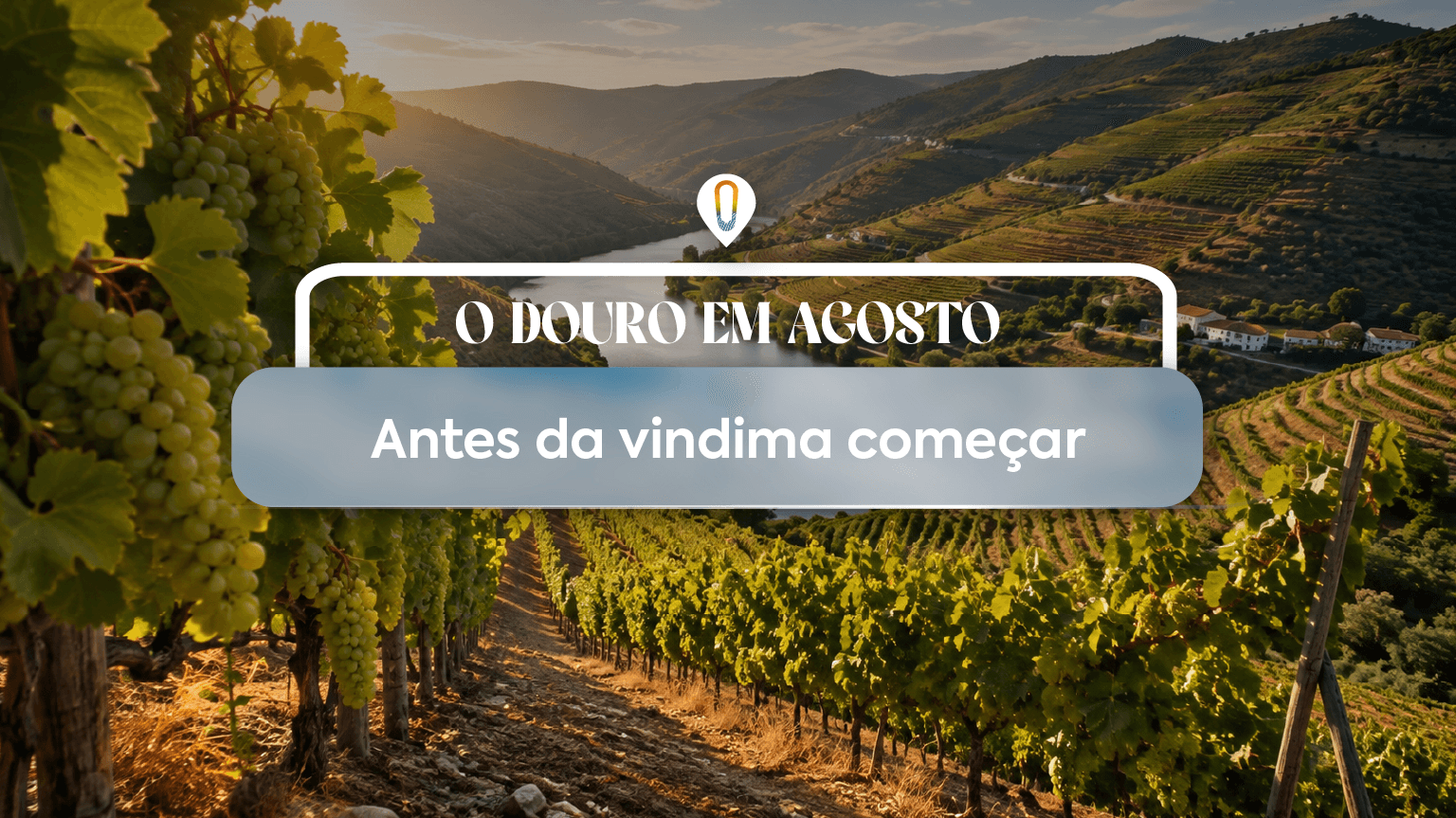
In August, the Douro seems to slow down. The heat settles over the valley, the river winds quietly between the hills, and the vineyards begin to take on the tones that signal the approach of harvest.
But beneath this apparent stillness, there is a great deal happening.
Before the first shears cut through the bunches of grapes, August is a decisive month for those who work in the vineyards. It is the time to monitor grape ripening, prepare the teams, organise the winery and wait for the right moment to begin harvesting.
The vineyard enters its final stage
Throughout summer, grapes undergo a rapid transformation. From small, firm and acidic green berries, they gradually become ripe, accumulating sugars and developing their aromas and flavours.
In August, vineyard workers closely monitor this evolution. The colour of the berries, acidity, sugar levels and the overall health of the grapes all help determine when each plot will be ready for harvest.
And there is no single harvest date for the entire Douro.
Altitude, slope orientation, soil type, grape variety and weather conditions mean that two relatively close vineyards can reach optimal ripeness at different times.
That is why harvest does not simply begin “on a given day”. It begins when each vineyard is ready.
Checking, tasting, deciding
In the weeks leading up to harvest, samples are often collected from different plots to assess how the grapes are developing.
It is not simply a matter of measuring sugar levels. Acidity, pH and other parameters help determine how the grapes are ripening and support the producer’s decisions.
But there is also a dimension that no laboratory analysis can completely replace: tasting.
By tasting a grape, it is possible to assess the texture of the pulp, the ripeness of the seeds, the intensity of the aromas and the balance between sweetness and acidity.
It is through this combination of data, experience and observation that the harvest begins to take shape.
Not all grapes ripen at the same time
One of the most fascinating characteristics of the Douro is the diversity of its landscape.
Vineyards stretch across slopes with different sun exposures and elevations, in distinct soils and microclimates. Even the composition of individual plots can vary considerably.
As a result, while one variety may already be approaching its ideal harvest point, another may need several more days.
Harvest therefore progresses gradually, plot by plot.
This difference in timing is also one of the reasons why the Douro landscape begins to change throughout August and September: first here, then there, the first signs appear that harvest is about to begin.
The invisible work before the first grape is picked
While the grapes are ripening, wineries and estates prepare everything that will be needed during the busiest period of the year.
Equipment is checked, crates and baskets are prepared, grape reception areas are organised and wineries begin getting ready to receive the new crop.
The teams are also organised.
Harvest traditionally involves many people and requires considerable logistics, particularly on the steepest plots, where manual harvesting continues to play an important role.
In the Douro, harvesting a vineyard can mean working on slopes where machinery is limited and every bunch is picked by hand.
And then there is the heat
August in the Douro is not simply a matter of the calendar.
High temperatures make monitoring grape conditions even more important. Heat can accelerate ripening and affect the balance between sugar and acidity, while periods of rain or other changes in weather can influence the ideal time to harvest.
That is why, at this time of year, eyes are focused both on the vineyard and on the sky.
A weather forecast can be enough to influence whether a particular plot will be harvested within a few days or can be left to mature for a little longer.
The landscape before it changes
For those visiting the Douro in August, this may be one of the most interesting stages of the year.
The characteristic bustle of harvest is not yet fully visible. The hillsides remain covered in green, grapes hang from the vines and, at many estates, silence still dominates much of the day.
But the landscape is about to change.
Over the following weeks, crates begin appearing among the vines, teams move along the slopes, tractors travel the vineyard paths and activity increases in the wineries. The pace accelerates and the region enters one of the most important moments of its agricultural calendar.
August is, therefore, a kind of interval between two moments.
The vineyard has already left much of its growing cycle behind, but harvest has not yet arrived. It is a period of observing, measuring, tasting and waiting.
The right moment cannot be forced
In the Douro, harvest depends on a decision that may seem simple, but involves countless variables: when is the grape truly ready?
There is no universal answer.
The right moment depends on the wine being produced, the grape variety, the plot, the vintage and the conditions of each vineyard.
That is precisely what makes August so important.
Before the wine reaches the winery, before the lagares receive grapes once again and before the first bunches are transformed, there is this quiet period of preparation.
And perhaps that is one of the best ways to look at the Douro in August: not as a region waiting for harvest, but as an entire landscape preparing for it.


